- Contact Us :
- 055-3412312-16
- info@mehboobgroupofindustries.com

Billet vs. Scrap: What is Your Steel Actually Made Of?

TR Girder vs. RCC Roof: Which is Best for Your Home?
December 20, 2025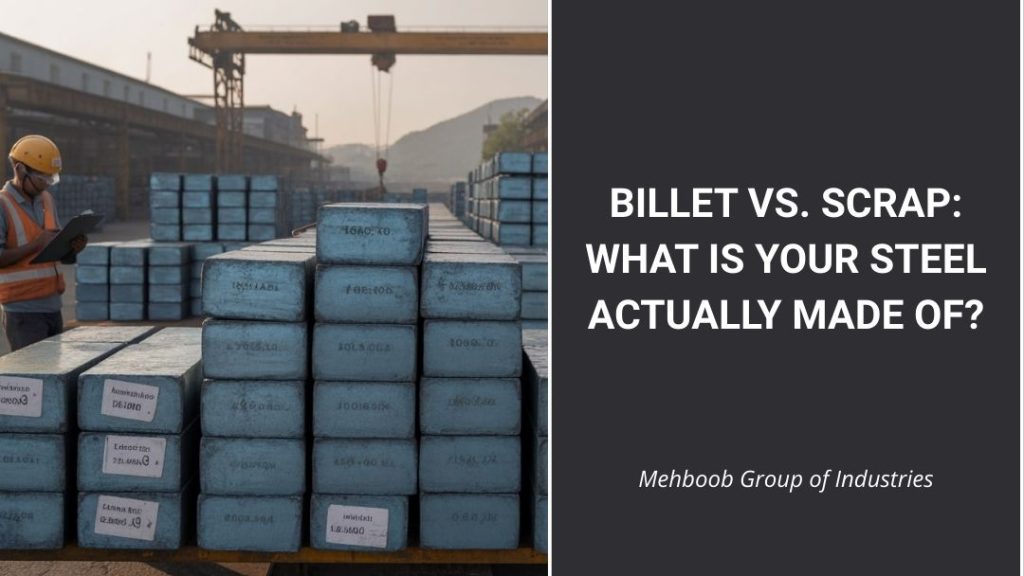
Pakistan’s construction industry processes millions of tons of steel annually. However, not all steel bars reinforcing our buildings share the same origin or quality. The fundamental question every contractor, engineer, and homeowner should ask is: what raw material went into making this steel?
The answer typically falls into two categories: virgin steel billets or recycled scrap metal. Understanding the billet vs. scrap distinction is essential for anyone involved in construction, manufacturing, or steel trading in Pakistan. This article examines both materials, their properties, and their impact on final product quality.
What is a Steel Billet? The Pure Block of Cast Steel
A steel billet is a semi-finished steel product with a square or rectangular cross-section, typically measuring 100mm to 150mm. These solid blocks serve as the primary raw material for manufacturing reinforcement bars (rebars), wire rods, and structural sections.
Billets are produced through two primary routes:
- Integrated Steel Plants (Blast Furnace Route)
Iron ore is reduced in blast furnaces, then refined in basic oxygen furnaces. The molten steel is cast into billets through continuous casting machines. - Electric Arc Furnace (EAF) Route
Selected, high-grade scrap is melted alongside direct reduced iron (DRI) or sponge iron under controlled conditions. This method allows precise control over chemical composition.
The critical distinction in the billet vs. scrap comparison begins here. Quality billets undergo rigorous chemical testing before leaving the steel melt shop. Each batch receives certification documenting carbon content, manganese levels, sulphur, phosphorus, and other trace elements.
In Pakistan, major integrated steel producers and reputable billet manufacturers supply certified billets to rolling mills. These billets arrive with mill test certificates, providing traceability from raw material to finished product.
The Impurity Problem: Why Ship-Breaking Scrap Has Hidden Weaknesses
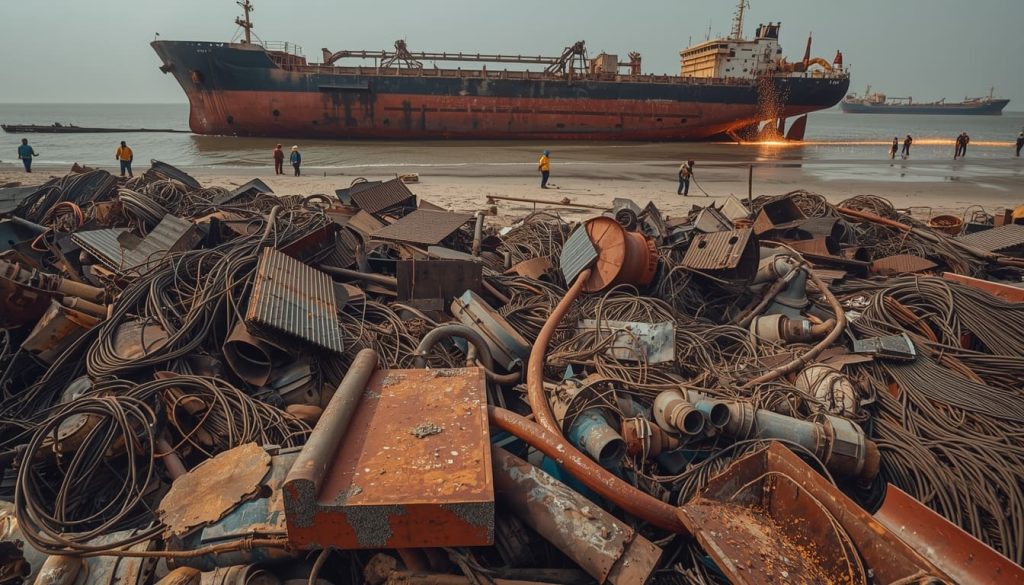
Pakistan operates one of the world’s largest ship-breaking industries in Gadani, Balochistan. While this industry provides employment and supplies steel to domestic markets, the metallurgical quality of ship-breaking scrap presents significant challenges.
Sources of Contamination in Ship Scrap:
- Mixed Steel Grades: Ships contain numerous steel typeshull plates, engine components, piping systems each manufactured to different specifications. When melted together, the resulting composition becomes unpredictable.
- Residual Elements: Decades of seawater exposure introduce chlorides and salts into the steel structure. Copper from electrical wiring, chrome from decorative fixtures, and nickel from specialized components contaminate the melt.
- Tramp Elements: Elements like copper, tin, and lead cannot be removed through conventional refining. Once present, they remain in the steel permanently, causing hot shortness and reducing ductility.
- Corrosion Products: Rust layers trap organic compounds, oils, and marine growth. These burn during melting but leave behind harmful residues.
The billet vs. scrap quality difference becomes apparent during tensile testing. Scrap-based steel frequently shows inconsistent strength readings within the same batch. One bar may meet standards while another fails both produced from the same heat.
Chemical Composition: How Billets Ensure Carbon and Manganese Balance
Steel properties depend directly on chemical composition. The relationship between carbon and manganese content determines strength, weldability, and ductility.
Carbon (C): 0.20% – 0.25% for standard rebars
Carbon increases hardness and tensile strength but reduces ductility. Exceeding optimal carbon levels creates brittle steel prone to sudden failure under seismic loads.
Manganese (Mn): 0.50% – 1.00%
Manganese improves strength through solid solution strengthening. It also combines with sulphur to form manganese sulphide, preventing hot shortness during rolling.
The Critical C: Mn Ratio
Quality billet producers maintain a carbon-to-manganese ratio between 1:3 and 1:4. This ratio ensures balanced mechanical properties.
Why Scrap-Based Steel Fails Here:
When scrap composition varies unpredictably, maintaining this ratio becomes impossible. Mills processing random scrap cannot achieve consistent chemistry. The result is steel that may test correctly in one sample but fail catastrophically in actual service.
Harmful Element Limits:
| Element | Maximum Allowed | Effect of Excess |
| Sulphur | 0.050% | Hot shortness, cracking during rolling |
| Phosphorus | 0.050% | Cold brittleness, reduced impact strength |
| Copper | 0.40% | Surface cracking, reduced weldability |
Quality billets arrive with these elements controlled within strict limits. Unknown scrap sources cannot guarantee such control.
Flexibility: Why Billet-Based Steel Bends Without Snapping
Ductility, the ability to deform plastically before fracturing separates quality construction steel from substandard material. Pakistan’s seismic zones, particularly in northern regions, demand steel that absorbs earthquake energy through controlled deformation.
Understanding the Bend Test:
Pakistani standard PS-1772 requires rebars to bend around a mandrel without cracking. The bend angle and mandrel diameter depend on bar size and grade. This test directly reflects raw material quality.
Why Billet-Based Steel Performs Better:
- Homogeneous Microstructure: Controlled cooling during billet casting produces uniform grain structure throughout the cross-section.
- Clean Steel: Lower inclusion content means fewer stress concentration points where cracks initiate.
- Consistent Carbon Equivalent: Predictable chemistry ensures predictable mechanical behavior.
Scrap Steel Failure Modes:
- Surface cracks appearing during bending
- Brittle fracture without warning deformation
- Inconsistent performance across the same batch
- Weld zone cracking during fabrication
The billet vs. scrap distinction directly impacts structural safety. Buildings reinforced with low-ductility steel transfer earthquake forces to connections and foundations, potentially causing progressive collapse.
The Manufacturing Process: The Induction Furnace Route
Understanding how scrap-based steel is produced in Pakistan reveals why quality control remains challenging.
Induction Furnace Steel Making:
Most small-to-medium Pakistani rolling mills operate induction furnaces. The process works as follows:
- Charging: Scrap metal loads into the furnace crucible
- Melting: Electromagnetic induction heats the charge to approximately 1600°C
- Refining: Limited induction furnaces cannot remove tramp elements
- Casting: Molten steel pours into billet molds
Key Limitation:
Induction furnaces melt what they receive. Unlike basic oxygen furnaces or electric arc furnaces with refining capabilities, induction furnaces cannot adjust chemistry significantly. If scrap contains 0.3% copper, the billet contains 0.3% copper.
Quality Control Measures Some Mills Employ:
- Segregating scrap by source and grade
- Blending scrap with virgin material
- Laboratory testing before and after melting
- Rejecting heats that fail chemical specifications
However, economic pressures often override quality considerations. When scrap prices fluctuate, mills may accept lower-grade material to maintain margins.
Making Informed Decisions
The billet vs. scrap choice ultimately determines structural reliability. Consider these factors when specifying steel:
For Critical Structures:
- Demand mill test certificates showing chemical composition
- Verify billet source and manufacturer
- Require third-party testing from PCSIR or other accredited laboratories
- Specify steel meeting PS-1772 or equivalent international standards
Price Considerations:
Quality billets cost more than random scrap. This cost difference reflects the quality difference. Attempting to save on reinforcement steel creates risks far exceeding material savings.
Verification Methods:
- Request heat certificates tracing steel to billet source
- Compare actual bar weights against theoretical weights (underweight bars indicate quality issues)
- Conduct independent bend and tensile tests
- Inspect bar surfaces for cracks, seams, or excessive scale
Conclusion
The Pakistani construction industry faces a clear choice regarding steel quality. While scrap-based steel costs less initially, the hidden costs of structural failures, earthquake vulnerability, reduced service life far exceed savings.
Understanding the billet vs. scrap distinction empowers engineers, contractors, and developers to make informed material choices. Quality steel begins with quality billets, manufactured under controlled conditions with documented chemistry.
As Pakistan’s building codes evolve and seismic safety requirements strengthen, demand for certified billet-based steel will increase. Those who understand this reality today will build structures that serve safely for decades.